Functional Programming in F#
Part I — Introduction
Steven Gilham
Based on material developed in collaboration with Will Harwood and Laurence Jordan and presented in 2008

|
Course Overview
|
Introduction to Functional Programming via circuits
Basic Concepts
|
|
Introduction to Functional Programming
|
Background
Caveat
This series covers functional-programming concepts, illustrated in F# syntax
It is intended as a way for beginners who have started to use the language to avoid just writing FORTRAN C/C++ old-school C# in an(y )other language.
It is not intended as an introductory guide to the language syntax itself, though I'll put in asides about the notations and concepts used.
What is F#?
- F# is a mature, open source, cross-platform, functional-first programming language
- F# Foundation at http://fsharp.org
- A .net language
- All the familiar tools and libraries
- One of the “ML” family of languages
- ML 1978
- CAML 1985
- OCAML 1996
- F# 2002
What is an “ML” language?
- First class functions
- Familiar from C# LINQ and the
delegate,ActionandFunctiontypes
- Familiar from C# LINQ and the
- Strict (“eager”) evaluation
- Arguments evaluated before calling functions
- Strongly typed with type inference
- Polymorphic (C# “Generic”) and user definable types
- Immutable by default
- Mutable references for controlled destructive updates
- Garbage Collection
- Exception Handling
What is Functional Programming?
- No one single agreed definition
- “The style of programming where your values are called i, k, and x
and your constructs are [something-or-other]-morphisms”
- Plenty of different morphisms to choose from! (examples)
- Programming where your functions are pure and your data immutable
- Programs as pipelines transforming your data
- As opposed to OO programming where data entities talk to one-another
Digital Circuits
Representation
Our first bit of syntax
|
|
Concept
An Algebraic Data Type
enumon steroids- Can have many values
- Can associate data
- Are a type (with closed set of sub-types)
- Avoid the Primitive Obsession anti-pattern
Concept
Code Fragments
- These examples are intended to execute in the F# interactive console.
- The ";;" syntax is an ML end-of-expression mark, required to tell the interpreter that there is a compilable unit to process now.
- They are not needed in project-based code
Operations
Functions and Pattern matching
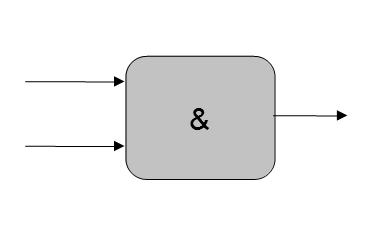
Basic operations AND, OR, NOT, XOR
|
|
Concept
Functions
ANDhas two arguments – parentheses are not used to group argument lists- Functions return the value of the last expression evaluated
- Everything is an expression.
Concept
Functions ctd.
- Neither
ANDnor its two arguments have explicitly specified types - The compiler inferred them; if it had been unable to, we would have to write
let AND (x:Bit) (y:Bit) : (Bit*Bit) = ... - The type of
ANDisBit -> Bit -> (Bit*Bit)
Concept
- A
matchexpression compares one value against an exhaustive list of options and results in the corresponding expression - The one value here is a tuple literal
- A simpler way of writing the exhaustive list is to use a wildcard “_” that matches anything
let AND x y =
  match (x, y) with
  | (One, One) -> One
  | _ -> Zero;;
Exercise 1.1
There will be more!
Define the standard Bit functions OR, XOR, NOT, NAND, NOR
Digression – Set-up for exercises
Getting and Running F#
- Repair install Visual Studio (or grab the latest upgrade if you aren't up to date),
and check the F# box under Programming Languages
- Or download Visual F# Tools 4.0 RTM (https://www.microsoft.com/en-us/download/details.aspx?id=48179)
- All these exercises will be done in F# interactive mode, either
- Open the F# Interactive Window in Visual Studio
- Run
'C:\Program Files (x86)\Microsoft SDKs\F#\4.0\Framework\v4.0\Fsi.exe'at a cmd or PowerShell prompt
Digital Circuits
Continues...
Binary Addition
An adder takes two streams of bits and produces a steam of bits as the answer
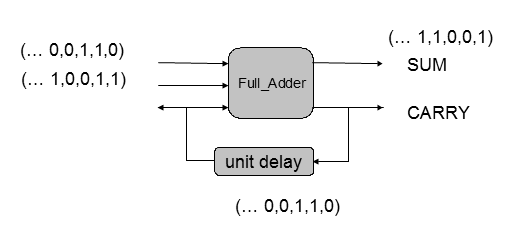
Initial Condition: carry output is Zero
Half-Adder and Full-Adder
| In standard fashion, we build an adder from two half-adders (which take two inputs and produce the XOR as the sum stream and the AND as the carry stream) | |
One half-adder takes the two inputs; the sum stream from that is passed into the second half-adder along with the previous carry bit, and the resulting sum forms the final output. The two intermediate carry streams are OR'd together to form the full carry stream |
|
Concept
- The “=“ is mathematical – the left hand side is that thing which satisfies the equation
- Binds a value to a name
- The LHS is a limited pattern match; a tuple RHS can be equated to a tuple LHS – a “destructuring” binding.
- Use “_” for a “don’t care value here too!
Exercise 1.2
Write Full_Adder as a pattern match operation, without any auxiliary half-adder function
Some Basic Tools
Lists and Streams
Basic functional concepts
|
|
Concept
- “//” introduces a comment for the rest of the line
- “(*” and “*)” indicate a block comment
- This “definition” of list is descriptive only
- “::” is the function (operator) that prepends an item to a list
- Infix operators are just functions with special syntax
Structural Recursion
Define a function by what it must do on each clause of the type definition
|
|
Concept
- “
rec” defines a recursive function - It simply means that the function's name is visible inside its own body
- To avoid the need for mutable counters or flags, recursion replaces loops for iterative operations.
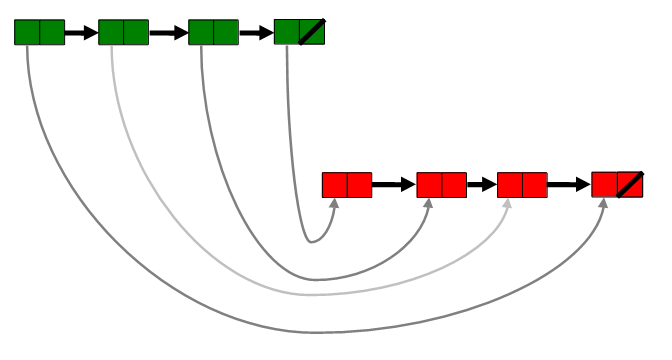
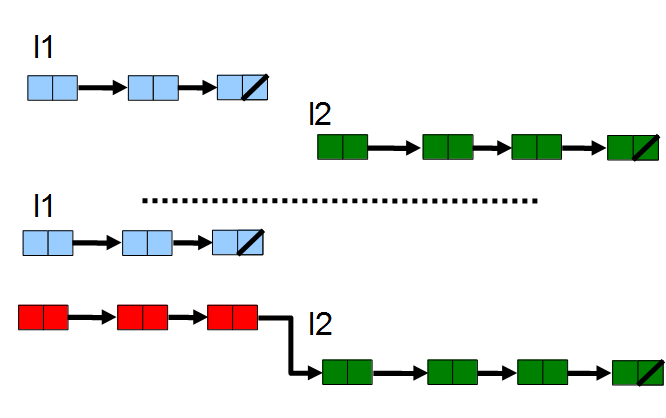
More Structural Recursion
|
|
Higher-order functions
Functions as values
let twice f x = f (f x);;fis a function- Parentheses group the sub-expression, making the order of evaluation explicit
(fun x -> x * x)- Lambda expression (free-standing anonymous function) to compute a square
- Implicitly of type
int -> int
(fun x -> x * x) 4;;- → 16
twice (fun x -> x * x) 4;;- → 256
Concept
- F# defines these very useful higher-order functions as infix operators
let (|>) f x = f x let (>>) f g x = f(g x) - So we can write
orlet twice f x = f |> f x;;let twice f = f >> f;; |>is F#'s answer to fluent syntax
Generalising
We can build upon the pieces
let rec power f n x =
  if n <= 0
    then x
    else power f (n – 1) (f x);;
Map/Reduce
- Apply a function to each element of a list, giving a new list
let rec map f l = match l with |[] -> [] |(x::xs) -> (f x)::(map f xs);; - Accumulate over a list
= f(x1, f(x2, … f(xn,c) … ))let rec reduce f c l = match l with |[] -> c |(x::xs) -> f x (reduce f c xs);; - Another definition of length
let len l = reduce ( + ) 0 (map (fun x -> 1) l);;
Concept
- In the expression
the infix operator “plus” is named in parentheseslet len l = reduce ( + ) 0 (map (fun x -> 1) l);; - This is the same as in the declaration of an infix operator function
- ! % & * + - . / < = > ? @ ^ | and ~ are allowed in user-defined (infix operator) function names
Exercise 1.3
- Define the function zip which when given two lists of the same length and returns a single list of pairs
zip [1;2;3] [Zero; One; Zero] → [(1,Zero); (2,One); (3,Zero)] - Define
itlistwhich takes a function f, an initial value v, and a non-negative integer n and returns a list of the iterates of f on v
itlist f v n → [v; f v; f(f v); f(f(f v))); ....; fn v] - Define
R_reduce f l c → f(xn...f(x2, f(x1, c)))
The Adder
The Adder
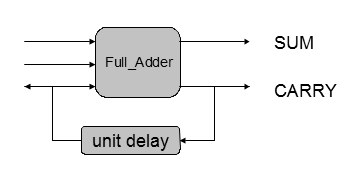
|
Note the lists are assumed to be in Least Significant Bit first order |
Tidying Up
|
|
Putting It All Together
let Adder bl1 bl2 =
  let (l1,l2) = pad ((dropleadingzeros bl1), (dropleadingzeros bl2))
  reverse(R_Adder (reverse (Zero::l1)) (reverse (Zero::l2)) Zero);;
Generalising : the Synchronous State Machine
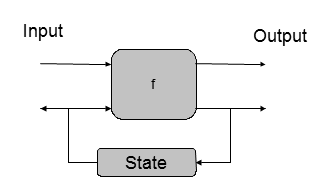
|
|